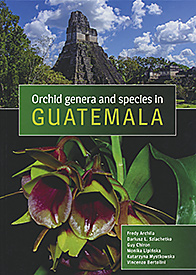
Orchid genera and species in Guatemala.
by/door Fredy Archila, Dariusz L. Szlachetko, Guy Chiron, Monika Lipińska, Katarzyna Mystkowska & Vincenzo Bertolini.
In English and Spanish, 724 pp., 315 colour photos of orchid species, some black-white photos.
Size/format A4.
Koeltz Botanical Books, Glashütten, Germany, 2018.
ISBN 978-3-946583-19-6
Other books edited by Koeltz Koeltz orchid books.htm
This book begins with a list of ‘Photo credits’ (most photos by Fredy Archila) on p. 8, a ‘Prologue’ by Fredy Archila Morales (p. 9-10) and an ‘Introduction’ (p. 1112).
The concept of genus is explained in ‘What is a genus?’ (p. 13-19), illustrated with a ‘morphological comparison-table’ between the genera Trichosalpinx and Tubella.
The chapter ‘Geographical framework’ (p. 21-36) situates the geological origin, the physical geography of Guatemala and the edaphoclimatic factors (latitude, topographic relief, plate movement, volcanic chain, rain systems) contributing to the orchid megadiversity in Guatemala.
‘Historic background of orchidology in Guatemala’ (p. 37-69) informs about the orchidology from the pre-Colonial times, during the Royal Expedition (Spain 1787-1803), after the independence (1821) and the importance of in orchidology well known people such as George Ure Skinner, James Bateman, Rudolf Schlechter, Oakes Ames etc… not to forget Fredy Archila’s Experimantal Orchid Station.
Then follows the chapter: ‘Classification of Orchids’ (p. 71-356) followed by ‘Checklist of the orchids of Guatemala’ (p. 493-717). Between both the ‘Gallery’ with 315 colour photos of Guatemalan orchid species (p. 359-491).
In ‘Classification of Orchids’ the authors follow Dalgren and Rasmussen (1983) and Szlachetko (1995) who recognised three families (Apostasiaceae, Cypripediaceae and Orchidaceae). Most of the recent authors treat them as one single family. In this chapter the authors present and describe the orchid genera in Guatemala. In the keys proposed by the authors only the genera reported in Guatemala are cited. First come the Cypripediaceae Lindl. (p. 75-80) with two genera: Cypripedium and Phragmipedium. Those are followed by the Orchidaceae Juss. (p. 80-356). A key to the subfamilies within the Orchidaceae is proposed (Orchidoideae, Vanilloideae, Neottioideae, Tropidioideae, Spiranthoideae, Epidendroideae and Vandoideae). Within each subfamily the genera in eventual tribes or subtribes are described. Where appropriate a key to the tribes, the subtribes or genera is proposed. The description of a genus is preceded by several important references such as author of the genus, publications, etc...
The ‘Checklist of the orchids of Guatemala’ (p. 493-717) is a long and alphabetic list of species names: name of the species with their authors, reference to the first description and eventual other relevant references. There is no description of the species.
At the end of this book we find ‘Selected References’ (p. 719-724).
Conclusion.
As far as I know, since ‘Orchids of Guatemala and Belize’ by Oakes Ames & Donovan St. Correll - the re-edition in one volume (1985) - there was no other comprehensive publication about the orchids of Guatemala. I am sure this very recent book can be an appreciated addition to Ames’s & Correll’s work.
Although, I find the concept somewhat chaotic: f.i. why there is no index published? At least one index with the chapter ‘Classification of Orchids’ had his place here because such an index would help a lot to find immediately the genus one is looking for. Now the reader has to guess where to find one or another tribe or subtribe. For this purpose the general index, named here ‘Contents’, is not helpful at all.
In aphabethical ‘The Checklist of orchids of Guatemala’ it is easy to find the species within a genus but some species names are not recognised by ‘Plants of the World online’. An example? Archila published the genus Selbyana in Revista Guatemalensis 13 (1): 66 (2010). This genus has the synonym-status for Lycaste in ‘Plants of the World’. And also this: In Richardina XVI 2015-2016 Archila published a new Lycaste-species: Lycaste annakamilae. Following Archila’s description this is a species from Guatemala. Lycaste annakamilae is not mentioned in this book but is on ‘Plants of the World online’ as an accepted species.
So, this book will be, as a list, an addition to ‘Orchids of Guatemala and Belize’ by Oakes Ames & Donovan St. Correll. Most of the photos in this new book are good to very good.
top
Dit boek begint met een lijst met ‘Photo credits’ (de meeste foto’s zijn van Fredy Archila) op p. 8, een ‘Prologue’ door Fredy Archila Morales (p. 9-10) en een ‘Introduction’ (p. 1112).
Het concept van het geslacht wordt uitgelegd in ‘What is a genus?’ (P. 13-19), geïllustreerd met een morfologische vergelijkingstabel tussen de geslachten Trichosalpinx en Tubella.
Het hoofdstuk ‘Geographical framework’ (p. 21-36) situeert de geologische oorsprong, de fysieke geografie van Guatemala en de edaphoclimatische factoren (breedtegraad, topografisch reliëf, beweging van de tektonische platen, vulkaanketens, regensystemen) die bijdragen aan de orchideeën-multi-diversiteit in Guatemala.
‘Historic background of orchidology in Guatemala’ (p. 37-69) informeert over de orchidologie vanaf de pre-koloniale tijd, tijdens de Koninklijke Expeditie (Spanje 1787-1803), de periode na de onafhankelijkheid (1821) en het belang van in de orchidologie belangrijke personen zoals George Ure Skinner, James Bateman, Rudolf Schlechter, Oakes Ames enz ... alsook het Experimantal Orchid Station van Fredy Archila in Guatemala.
Dan volgt het hoofdstuk: ‘Classification of Orchids’ (p. 71-356) gevolgd door ‘Checklist of the orchids of Guatemala’ (p. 493-717). Tussen beide de ‘Gallery’ met 315 kleurenfoto's van Guatemalteekse orchideeënsoorten (p. 359-491).
In ‘Classification of Orchids’ volgen de auteurs Dalgren en Rasmussen (1983) alsook Szlachetko (1995) die drie families erkennen (Apostasiaceae, Cypripediaceae en Orchidaceae). De meeste auteurs behandelen deze drie als één familie. In dit hoofdstuk presenteren en beschrijven de auteurs de orchideeëngenera in Guatemala. In de door de auteurs voorgestelde sleutels worden alleen de in Guatemala gerapporteerde geslachten genoemd. Eerst komen de Cypripediaceae Lindl. (p. 75-80) met twee geslachten: Cypripedium en Phragmipedium. Die worden gevolgd door de Orchidaceae Juss. (p. 80-356). Een sleutel tot de subfamilies binnen de Orchidaceae wordt voorgesteld (Orchidoideae, Vanilloideae, Neottioideae, Tropidioideae, Spiranthoideae, Epidendroideae en Vandoideae). Binnen elke subfamilie worden de geslachten in eventuele tribu of subtribu beschreven. Waar nodig wordt een sleutel tot de tribu, de subtribu of de geslachten voorgesteld. De beschrijving van elk geslacht wordt voorafgegaan door verschillende belangrijke referenties.
De ‘Checklist of the orchids of Guatemala’ (p. 493-717) is een lange en alfabetische lijst van species: naam van de soort met hun auteurs, een verwijzing naar de eerste beschrijving en eventuele andere relevante referenties. Er is geen beschrijving van de soort.
Aan het einde van dit boek vinden we ‘Selected References’ (p. 719-724).
Conclusie.
Voor zover ik weet, was er sinds ‘Orchids of Guatemala and Belize’door Oakes Ames & Donovan St. Correll - de heruitgave in één deel (1985) - geen andere gelijkwaardige publicatie over de orchideeën van Guatemala. Ik ben er zeker van dat dit zeer recente boek een gewaardeerde toevoeging kan zijn aan het werk van Ames & Correll.
Hoewel ik het concept enigszins chaotisch vind: bv. waarom wordt er geen index gepubliceerd? Ten minste één index voor het hoofdstuk ‘Classification of Orchids’ had hier zijn plaats, omdat een dergelijke index veel zou helpen om onmiddellijk het geslacht te vinden waarnaar men op zoek is. Nu moet de lezer raden waar hij een of andere tribu of subtribu kan vinden. Voor dit doel is de algemene index, hier ‘Contents’genoemd, helemaal niet nuttig.
In het alfabetische ‘The Checklist of orchids of Guatemala’ is het gemakkelijk om een soort binnen een geslacht te vinden maar sommige soortnamen worden niet erkend door ‘Plants of the World online’. Een voorbeeld? Het door Archila beschreven geslacht ‘Selbyana’, gepubliceerd in Revista Guatemalensis 13 (1): 66 (2010), heeft bij ‘Plants of the World’ de status van synoniem voor Lycaste.
En ook dit: in Richardina XVI 2015-2016 publiceerde Archila een nieuwe Lycaste-soort: Lycaste annakamilae. Volgens de beschrijving van Archila is dit een soort uit Guatemala. Ze wordt niet in dit boek vermeld maar staat wel op ‘Plants of the World online’ als een geaccepteerde soort.
Dit boek kan dus als opsomming een toevoeging zijn aan ‘Orchids of Guatemala and Belize’ van Oakes Ames & Donovan St. Correll. De meeste foto’s in dit nieuwe boek zijn goed tot zeer goed.
top